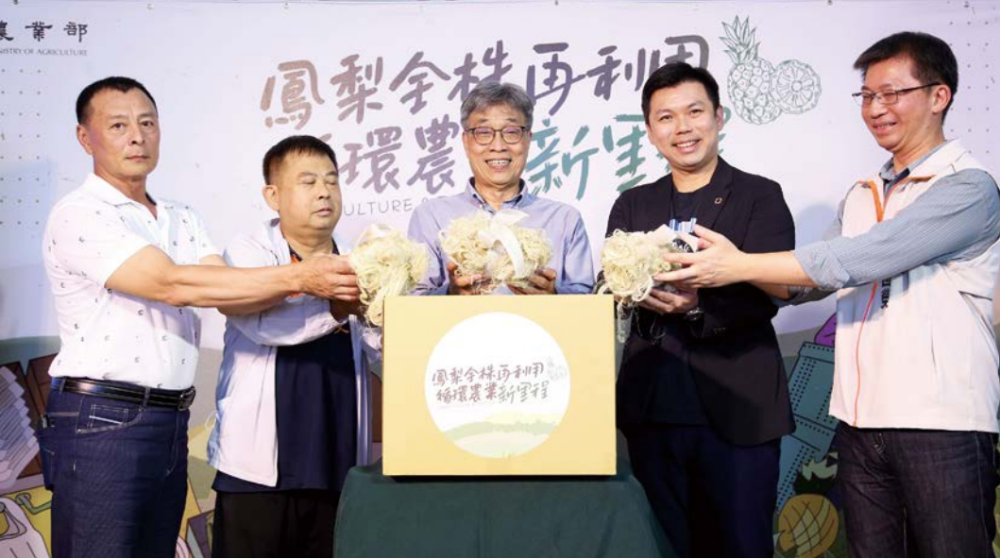
To achieve the policy objectives of "total circulation and zero waste" and a net-zero agricultural transition, Taiwan's Ministry of Agriculture (MOA) has targeted pineapples—a vital economic crop—to introduce circular economy concepts and successfully construct a pineapple circular industry ecosystem. Through strategies encompassing technological R&D, regulatory adaptation, public-private partnerships, and international networking, this initiative transforms massive volumes of agricultural residual resources into high-value materials for the biomedical, textile, and consumer goods sectors, setting a new milestone for sustainable agriculture in Taiwan.
1. Industry Background and Pain Point Analysis
The annual harvested area of pineapples in Taiwan reaches approximately 6,987 hectares; however, post-harvest operations leave a staggering 700,000 to 800,000 tons of stems and leaves in the fields. Traditionally, agricultural practices involved tilling these residues directly into the soil, which not only incurred additional processing costs and delayed subsequent farming schedules but also harbored risks of lingering pests and diseases. Nevertheless, with proper extraction and processing, these biomass materials possess tremendous commercial potential and economic value in fields such as silage, biomedicine, consumer products, and textiles. Consequently, the MOA has spearheaded industrial upgrading based on six core strategies: technological R&D, regulatory adaptation, site construction, industry participation, social communication, and agricultural ESG.
2. Technological Breakthroughs and Automated Mass Production
Enhancing the efficiency of material collection and processing is the primary key to industrialization:
Mechanized Harvesting Upgrades: The traditional manual harvesting capacity for pineapple leaves was limited to approximately 200 to 300 kilograms per person per day. Following the development of the "pineapple plant harvester" and "pineapple stem and leaf separator" by the Kaohsiung District Agricultural Research and Extension Station, harvesting capacity has surged to 1,000 kilograms per hour, effectively conserving agricultural labor and optimizing operational fluidity.
High-Value Processing and Extraction: The separated pineapple stems can be further refined to extract pineapple enzymes, which are widely utilized in feed additives, food processing, and medical dressings.
Automated Fiber Extraction: The Agriculture and Food Agency has assisted enterprises in adopting automated fiber extraction equipment capable of processing 150 kilograms of pineapple leaves per hour. For instance, leaves from 0.5 hectares of land can yield about 100 kilograms of pineapple leaf fiber, which translates to approximately 7,500 natural regenerated fiber T-shirts. The deployment of this technology not only stabilizes the material supply for the textile industry but also generates an additional income of over NT$10,000 per 0.1 hectare for farmers, supplementary to fresh fruit revenues.
3. Quality Standardization and Public-Private Partnerships
To establish the international competitiveness of domestic fibers, the MOA collaborated with academic and research institutes to compare samples from six countries (the Philippines, Thailand, Vietnam, Indonesia, India, and Kenya). Scientific empirical evidence confirms that Taiwanese pineapple leaf fiber possesses four absolute advantages: long fiber length, high strength, moderate gum content, and low impurity rates.
Regulations and Standards: In 2025, Taiwan officially reviewed and issued its first "Pineapple Leaf Fiber Quality Standard," utilizing these scientific data as a pricing reference and effectively differentiating domestic fibers from inferior imported products.
Supply Chain Integration: Through the "Circular Agriculture Industry Participation Project," Jin Yi Enterprise established a regional demonstration site in Guanmiao, Tainan, converting dried leaf residues into livestock bedding and cat litter. Simultaneously, U-Long Corporation integrated upstream and downstream sectors to form a "National Team for the Pineapple Fiber Industry," successfully exporting optimized blended apparel to countries such as the US, Japan, and Vietnam. The first batch of 100 kilograms of mass-produced fiber was officially shipped in June 2025.
4. Circular Recycling System for Agricultural Plastic Films
Addressing the plastic mulch waste generated during pineapple cultivation, the Agriculture and Food Agency has also constructed a comprehensive circular mechanism for non-biological residual resources. Because recovered agricultural films are often heavily mixed with soil and stones—impeding processing—the agency guided operators to construct a dedicated agricultural plastic recycling and washing facility in Dongshi, Chiayi. Through an integrated operation of crushing, washing, and drying to remove impurities, the films smoothly transition into the plastic recycling system to produce eco-friendly tableware and artificial leather. Aligning with the "Operational Guidelines for the Field Recovery, Transportation, and Washing Circulation of Recyclable Agricultural Plastic Materials" announced in 2025, the collection standards for 7 categories of agricultural plastics have been further formalized.
5. International Participation and Future Outlook
In October 2025, Taiwan hosted the "2025 Asia Pacific Circular Economy Roundtable & Hotspot" and released the draft of the "2050 Taiwan Circular Economy Roadmap". At the forum, the MOA presented its whole-plant pineapple utilization biomass circular model to nearly 200 international decision-makers from 15 countries, demonstrating the sustainable innovation capabilities inherent in the "Taiwan Can Lead" ethos. Looking forward, the Ministry of Environment has planned a circular product labeling system, while the MOA will actively pursue R&D on new regenerated fibers like banana pseudostems. By deepening corporate matching via the "Agriculture ESG STORE" platform, Taiwan is steadily advancing toward its 2040 net-zero agricultural vision.
【For full details, please refer to the document】: 推動農業全循環零廢棄—鳳梨循環產業生態系之實踐 (Promoting Zero-Waste Circular Agriculture—The Practice of the Pineapple Circular Industry Ecosystem).