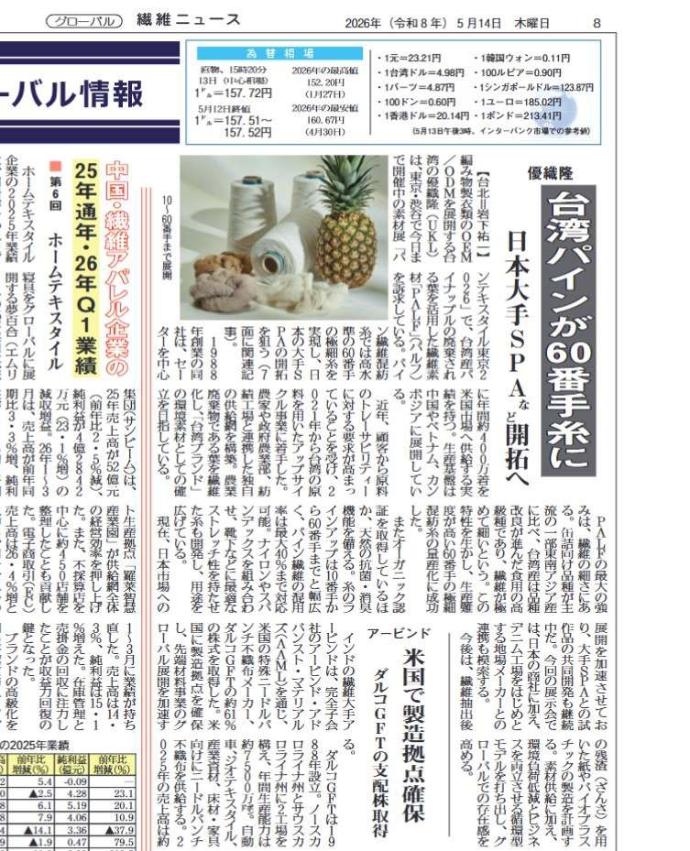
UKL will debut its "60-count ultrafine pineapple leaf fiber (PALF)" at PAN TEXTILES TOKYO 2026, targeting mainstream Japanese fashion and spa brands.
Product: Overcoming the coarseness of previous fibers, it creates a delicate, skin-friendly yarn suitable for high-end sportswear and fashionable shirts.
Advantages: Made from recycled agricultural waste, it possesses natural antibacterial properties, can be blended up to 40%, and is organically certified.
Strategy: Expanding into the Japanese market through a dual-track model of raw material supply and garment sales.
At the recently concluded "PAN TEXTILES TOKYO 2026" in Belle Salle Shibuya First, UKL once again demonstrated its strong green R&D capabilities. With "sustainability, high performance, and multi-faceted market satisfaction" as its core focus, UKL successfully attracted significant attention from major Japanese fashion giants and renowned spa brands thanks to its proprietary "60s ultra-fine pineapple leaf fiber" and a range of high-performance sustainable fabrics.
This Tokyo exhibition marks a significant milestone for UKL in deepening its presence in the Japanese market. According to a special report by the authoritative Japanese media outlet *Fiber News*, UKL, a leading OEM/ODM manufacturer with global manufacturing and supply chain capabilities, has been actively transforming itself towards sustainable and high-value-added materials in recent years. The core focus of this exhibition is its Pineapple Leaf Fiber (PALF) technology, which, after years of development, successfully transforms agricultural waste into high-end textiles.
In the past, pineapple leaf fiber, due to its high rigidity and difficulty in refining, was mostly used in coarse yarns or heavy fabrics. Through close collaboration with government agricultural departments and textile research institutions, the UKL R&D team successfully overcame technical bottlenecks and unveiled its first 60s ultra-fine pineapple yarn. This innovation significantly expands the application boundaries of sustainable materials, allowing pineapple fiber to not only exhibit the refreshing touch and unique balance of strength and softness like natural hemp fiber, but also to be widely used in high-end golf apparel, fashionable shirts, and men's and women's casual outerwear where fineness and skin-friendliness are paramount.
PALF's core functions and environmental sustainability advantages:
Agricultural waste recycling: Recycling pineapple leaves discarded from local farmland in Taiwan achieves a circular economy from the source, resulting in significant carbon reduction benefits.
Natural antibacterial and deodorizing properties: PALF fibers naturally possess excellent antibacterial and odor-suppressing properties, requiring no added chemical additives.
Multiple golden blend ratios: Offers a variety of blending options, with a maximum blending rate of 40%, and can be combined with elastic yarns to inject excellent comfort and stretch into hosiery and functional apparel.
International Organic Certification: We have obtained authoritative organic certification, meeting the stringent requirements of global brands for the traceability of raw materials.
UKL currently has established robust production bases in China and Southeast Asia, possessing a solid production capacity to supply approximately 4 million high-quality garments annually to major retailers and fashion brands in the US and globally. Looking ahead, UKL will continue to focus on "innovative environmental materials" as its core driving force, transforming its new PALF technology into a core revenue stream for the brand. It will also actively seek collaborative development with local Japanese textile mills, denim workshops, and large SPA chain groups, employing a dual-track business model of "material supply" and "finished garment proposals" to allow sustainable innovation from Taiwan to shine globally.